
One practice session, a camera, and six filmed swings produced GOATY's new teaching sequence — with numbers proving every step.
Most golf instruction starts with an opinion. This started with a measurement.
We took the GOAT Model's swing — the benchmark GOATY compares every swing against — and asked one question: what does the lead hip actually do, in numbers? Not "clears," not "fires." Numbers, frame by frame, normalized so any golfer's body can be compared to the model directly.
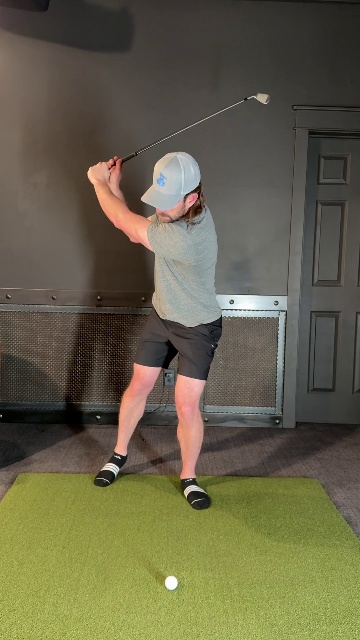
Then our founder stepped in front of the camera as the guinea pig and filmed six swings in one session — each testing a single idea, each measured against the GOAT Model with the same pipeline. What came out of it is a five-step sequence — the same five steps GOATY now teaches in live lessons and swing analysis. Below is each step, with the camera frames showing exactly where his swing was off, the feel that fixed it, and the numbers that prove it.
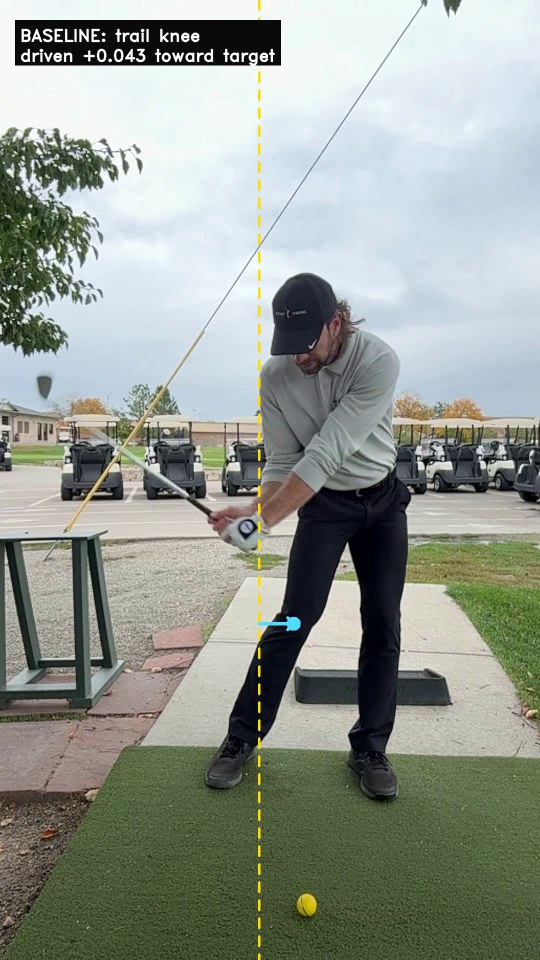
The most common amateur power move there is: pushing off the trail side. The test golfer's trail knee was driving toward the target at mid-downswing (+0.043 on our shoulder-width scale) while the GOAT Model's trail knee hasn't moved toward the target at all at that moment — it's still slightly behind where it started at address (−0.024). The push feels powerful. It also disengages the lead hip, forces early extension, and shoves the arms over the top.
The five-minute fix: drop the trail foot back so the toes sit level with the lead arch, weight fully on the lead side. Pushing is now physically impossible — the only way to swing is to let the lead glute drive the hip.

Here's what it looks like on camera. The dashed line marks where the trail knee started at address. In the baseline swing the knee has driven well past it toward the target — the classic push. After the drill, the knee is still sitting on its line at the same point in the downswing:

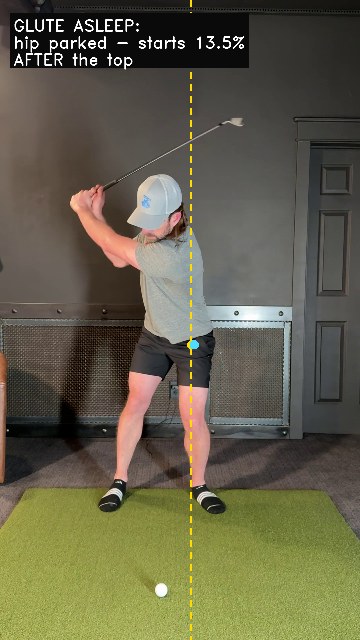
The lead glute can't act at the top if it has to wake up first. With the push gone, the camera exposed the next leak: the lead hip wasn't starting until 13.5% into the downswing — the arms were already falling before the hip ever moved. The fix wasn't to fire anything harder. It was to keep the outside of the lead glute switched on during the backswing — prepped, not fired. That alone moved the hip's start time to the instant the club reached the top, and by the final swing, before the top. That early, organized start is the GOAT Model's signature transition (his hip starts at 5.7%).
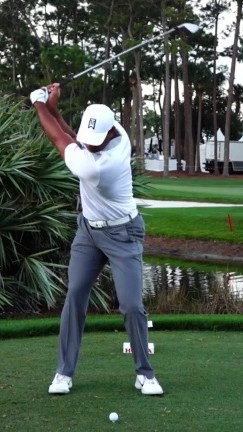
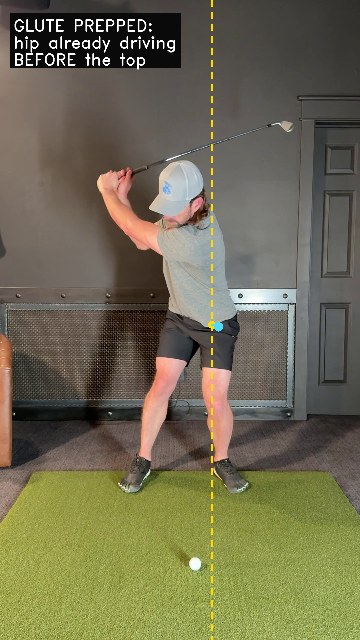
When the golfer simply tried to "jump off the lead leg," the camera caught a spin-out — lead foot snapping open, hip never getting over the lead ankle, ball blocked right. The model does something different: it falls into the lead side early and stacks the lead hip over the lead ankle before extending.
The fix came from the lead inner thigh: engage the adductor so the lead leg becomes an angled post that keeps tipping toward the target. The body falls left while the chest stays closed — and because the post bounds the motion, the trail side never needs to push.
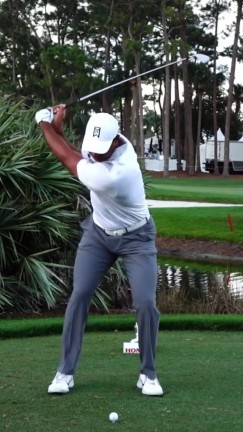
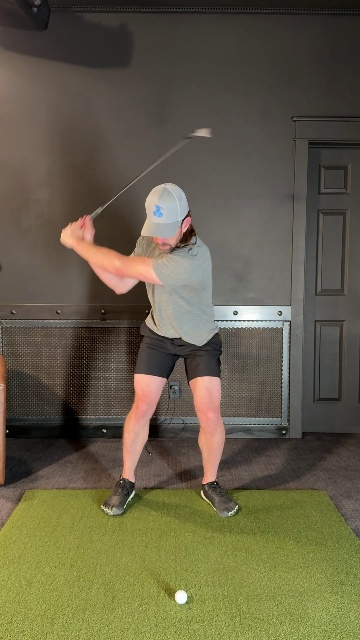
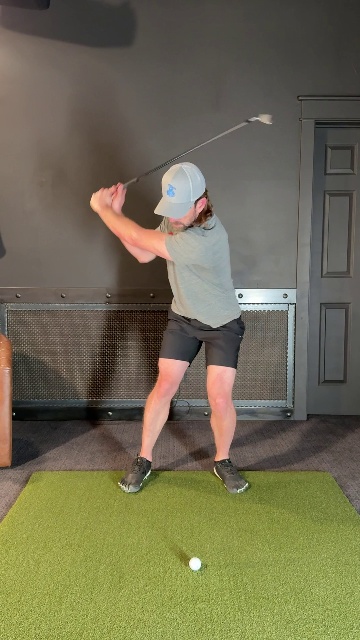
Extension isn't the enemy — early extension is. The same jump that produced the spin-out becomes the power source the moment it launches from a stacked post instead of from behind it. This is why Step 4 stays locked until Step 3 passes: the camera proved that the identical move, out of order, produces the opposite result.
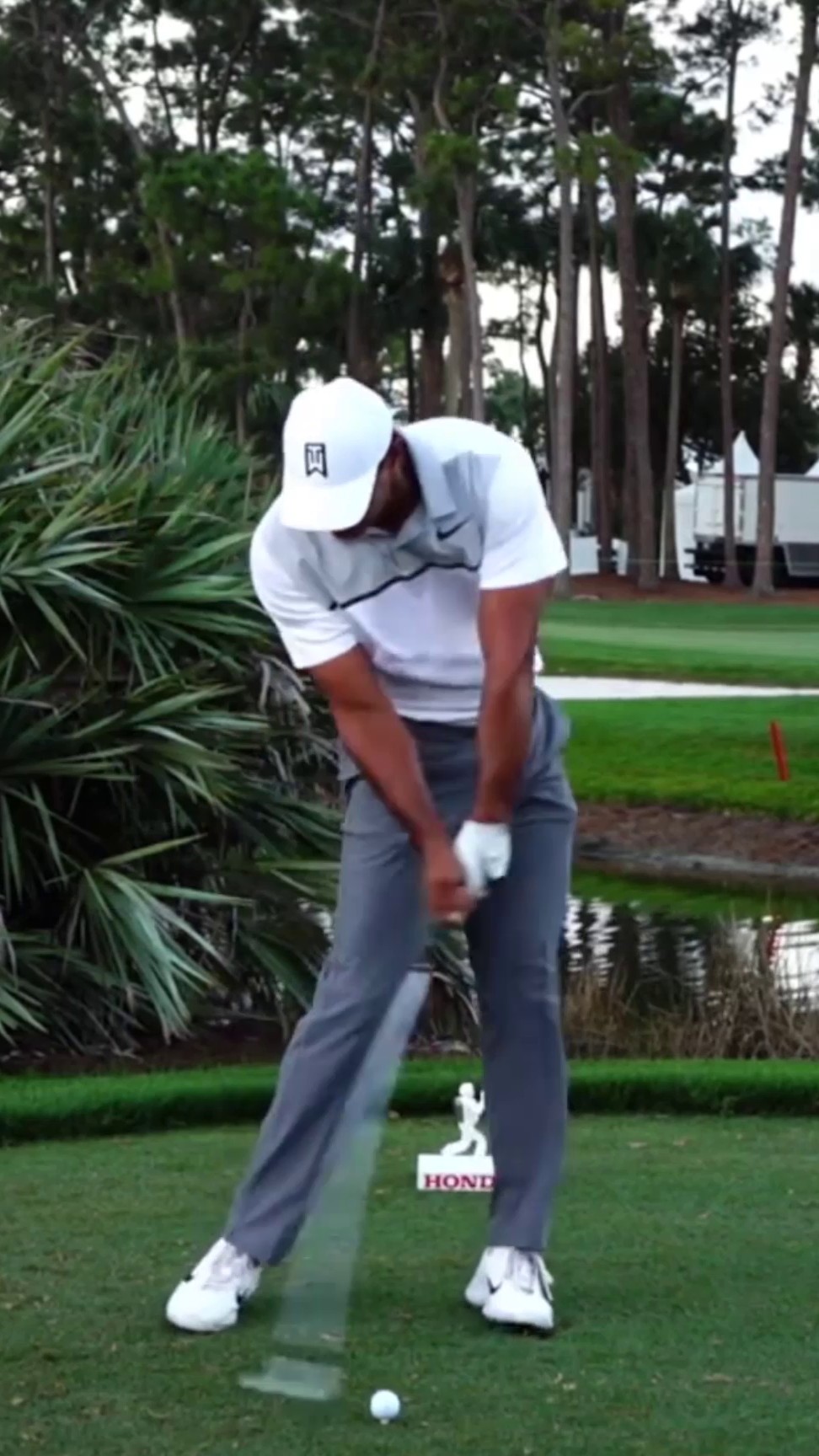
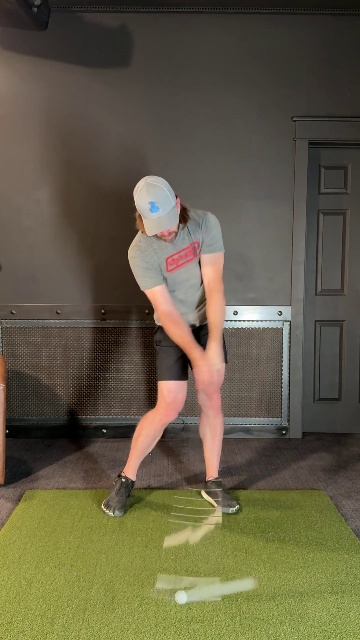
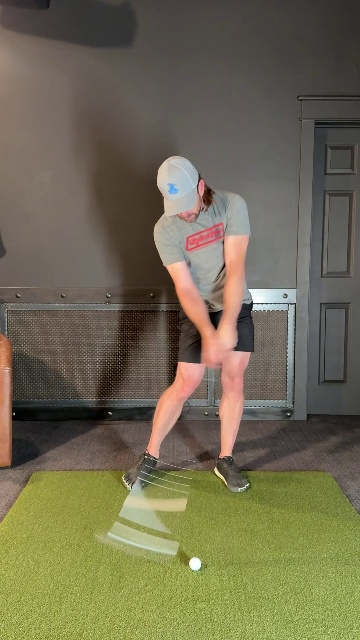
Six swings, one session. Every row is a measurement against the GOAT Model (shoulder-width normalized). Watch the numbers converge as each feel was added:
The "jump too early" column is the ablation proof: identical jump intent, but without the lead hip stacked over the ankle — the result was a spin-out and a block. One ingredient, opposite outcome. The order is the curriculum.
Everyone sees how the GOAT Model's head stays down through impact and assumes "squat." The measurement says otherwise: at impact the model's pelvis is already back UP — the legs are extending hard — while the trail shoulder is crushed 0.11 lower and the lead shoulder is rising. The low head is side bend, not squat. Side bend is what spends the jump without lifting the head.
The shoulder lines make it visible. The cyan line connects the shoulders at impact; the dashed yellow line is level. The GOAT Model's trail shoulder is crushed far below level — and this is the one checkpoint still open in our founder's own swing. His best swing of the session reached 0.145 of shoulder tilt against the model's 0.289 — the tilt is appearing, but there's a step left to climb:

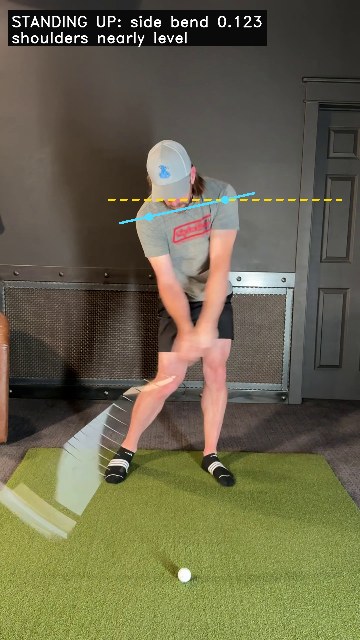

Four steps matched in one session; the fifth is the work in progress. That's exactly how the sequence is supposed to feel: you always know which step you're on, and the camera tells you when you've passed it.
This session produced GOATY's new teaching roadmap — every step measurable, each step unlocking the next:
1. Kill the push — the Lead Post drill; the camera grades your trail knee. Most golfers feel more solid contact within minutes.
2. Prep the lead glute — switched on in the backswing, pulling from the top.
3. The angled post — fall left, stack the lead hip over the lead ankle, stay closed.
4. Jump from the stacked post — extension isn't the enemy; early extension is. Locked until step 3 passes.
5. Side bend through impact — the piece that turns the jump into compression instead of a stand-up.
GOATY measures where you are in the sequence, shows your number next to the GOAT Model's, and coaches the one step you're on — in live lessons, swing analysis, and chat. Master this, then this, then this — and watch your numbers converge on the greatest swing of all time.
Feel Step 1 Today — Free Live Lesson with GOATY
No subscription required. GOATY coaches you in real time on every rep, every swing, every session.
Try a Free Live Lessonor start with a free swing analysis
Analyze My Swing Free