
The Importance of a Flat Lead Wrist at Impact
When it comes to striking the golf ball, achieving a flat lead wrist at impact is crucial for maximizing compression and improving overall performance. However, the common misconception among many golfers is that they need to actively bow or flatten their lead wrist during the swing. In reality, this position should happen naturally as a byproduct of proper body movement.
Understanding Compression in Your Swing
Compression plays a vital role in how you feel when you strike the ball. It affects the sound, ball flight, and overall performance. The key to achieving this compression lies in the positioning of your lead wrist at impact. Rather than focusing solely on the wrist, it’s essential to understand the movements of your body and how they influence the wrist's position.
The Role of Body Movement
To achieve a flat lead wrist, you must first understand that it relies on the way your body and arms are moving during the swing. Specifically, your arms and hands should move in the opposite direction of your body's rotation. This might sound counterintuitive, but it's a critical aspect of creating an effective swing.
Visualizing the Impact Position
Let’s visualize the impact position. Imagine drawing a line from your shoulder to the ground. At impact, your lead shoulder should be higher than your trail shoulder. This upward movement of the lead shoulder, combined with a downward movement of the trail shoulder, creates what is known as side bend. This side bend is essential for generating parametric acceleration, which is the key to a powerful release at impact.
Creating the Proper Elbow Position
Another crucial element of achieving a flat lead wrist is the positioning of your elbows. At impact, your right elbow should point outward, with your right palm facing away from your body. Your lead elbow should be directed straight down the target line. This alignment not only facilitates a flat lead wrist but also contributes to an effective swing path.
The Role of Lateral Shift
An essential movement that allows for this positioning is a lateral shift of your hips during the downswing. When your hips shift back, it creates space for your elbow to drop into the correct position. If you struggle to achieve this, it might indicate that your hips are blocking this movement, making it difficult to reach the necessary angles.
Snapping the Release
The final piece of the puzzle is snapping the release at the last moment. As your lead shoulder rises, it pulls the handle of the club upward while simultaneously slowing down the forward momentum of the club. This allows you to create that crucial snap effect that enhances ball compression.
Drills to Practice
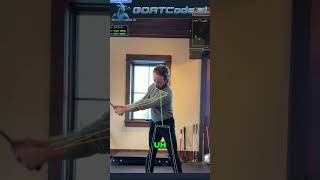
Now that we’ve covered the theory behind achieving a flat lead wrist at impact, it’s time to put it into action. A simple drill to practice is to focus on the movement of your lead arm in the opposite direction of your hips and torso during the downswing. By paying attention to these movements, you can start to feel the proper positioning of your wrist and elbows at impact.
Key Takeaways
- A flat lead wrist at impact should happen naturally, not by force.
- Body movements, including lateral shifts and shoulder positioning, are critical for achieving proper wrist alignment.
- Parametric acceleration is created through side bend and upward shoulder movement.
- Practice drills focusing on the opposite movement of your arms and body to improve wrist positioning.
- Understanding these concepts can lead to better compression and improved ball striking.
See What GOATY Finds in Your Swing
Upload a swing video and get your GOATScore, root cause diagnosis, and personalized drill prescription in 60 seconds.
Analyze My Swing Freeor
Try a Free Live LessonRelated Articles
Unlock Your Golf Swing: Master the Loading Secret
Discover how to load your golf swing like the GOATs with this essential technique. Improve your game with expert tips an

Master Your Golf Swing: Trail Side Loading & Hand Speed
Learn to load into your trail side and measure hand speed for a powerful golf swing. Unlock peak performance with expert

Master Your Golf Swing: Fix Arms and Load Right
Learn to fix your arms and load properly for a powerful golf swing with expert tips from Chuck Quinton.