
Introduction to Hackmotion Data
In the world of golf instruction, understanding your swing data is crucial for improvement. Many golfers turn to tools like Hackmotion to analyze their swings, but interpreting this data can be challenging. In this article, we'll explore how to effectively use Hackmotion data, drawing from insights gained during my recent tournament round where I shot a solid 6 under par, 66.
Understanding the Release Pattern
One common misconception among golfers is that their swing data must perfectly align with that of elite players. While comparing our data to the GOAT Model can be helpful, it’s essential to realize that everyone has their unique pattern. What matters is understanding the broad strokes of your own data and how it correlates to your performance on the course.
Analyzing My Tournament Data
During my tournament round, I noticed that my swing data showed a gradual flattening and a slight loss of extension as I moved through the swing. Specifically, I still maintained around four to five degrees of extension at the top of my swing. This extension is represented by the orange or orangish-yellow line on the graph found in Hackmotion data, illustrating how my wrist position changes throughout the swing.
Key Metrics: Extension and Impact
As I transitioned into the downswing, I observed a smooth curve in my extension, leading to an impact angle of -6 degrees. This wrist position is crucial for de-lofting the club, allowing me to strike the ball consistently. It’s important to note that such a gradual slope in my data is not only acceptable but also effective. This stable release pattern contributes to my ability to hit the ball predictably.
Understanding Wrist Movements
Another critical aspect of my Hackmotion data was the amount of ulnar deviation throughout my swing. I had slightly more deviation than the GOAT Model but maintained a gradual and smooth curve. At the moment of impact, my wrist unleashed tremendous speed, transitioning from +8 to 44 mph. This release of the right hand is where I truly feel the club's acceleration, and I focus on preparing for the downswing right from the takeaway.
The Importance of a Stable Release Pattern
It’s vital to grasp the connection between wrist movement and clubhead speed. Notice how the patterns of flexion, extension, and rotation correlate just before impact; these elements ramp up simultaneously, allowing for a square clubface at contact. This synchronization is key to achieving the proper release and hitting straight shots.
Finding Your Unique Swing Pattern
If you’re unsure about what your data should look like, aim for a release pattern that resembles mine—a stable and smooth transition that leads to consistent shots. Remember, it’s about finding what works best for you and identifying the elements of your swing that feel comfortable and effective.
Using AI for Swing Analysis
Leveraging AI swing analysis tools can further enhance your understanding of these patterns. By inputting your data into an AI platform, you can receive tailored insights that highlight your unique swing characteristics and areas for improvement, helping you to refine your technique.
Conclusion
In conclusion, while it’s easy to get caught up in the desire to mimic elite players, the most important factor is understanding and utilizing your own data effectively. Use your Hackmotion data as a guide to discover the nuances of your swing pattern, and focus on achieving that stable, consistent release that leads to better performance on the course.
Key Takeaways
- Your swing data should reflect your unique pattern, not just mimic the elite model.
- Focus on gradual changes in wrist position for a stable release.
- Understand the correlation between wrist movements and clubhead speed at impact.
- Utilize AI swing analysis for personalized insights into your swing.
- Find what feels right for you and use your data to build a reliable swing.
See What GOATY Finds in Your Swing
Upload a swing video and get your GOATScore, root cause diagnosis, and personalized drill prescription in 60 seconds.
Analyze My Swing Freeor
Try a Free Live LessonRelated Articles
Enhance Your Golf Swing with AI Comparison Tools
Utilize AI tools to compare your swing to elite models and improve your game. Learn how to analyze your stance and hip l
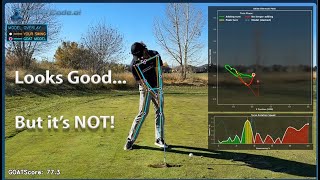
Understanding Golf Swing Analysis: Why Your Eyes Lie
Discover why relying on your eyes for golf swing analysis can mislead you. Learn how AI can provide accurate insights in

Learn to Swing Like the GOAT Model for Perfect Golf Technique
Discover how to analyze your swing using the GOAT Model and improve your golf game with real-time feedback.