
Introduction
Many golfers are often confused about the role of their hips during a swing. There's a common misconception that hips should remain static and not move laterally. However, understanding the dynamics of hip movement can significantly enhance your swing performance. In this article, we will explore the importance of lateral hip movement and how it contributes to generating power in your golf swing.
The Misconception of Static Hips
It’s easy to fall into the trap of thinking that keeping the hips completely still is the secret to a good golf swing. This belief stems from a misunderstanding of how the body functions during the swing. In reality, modern equipment and technology, such as Trackman, allow us to see that there is indeed lateral movement in a successful swing.
Understanding Hip Movement Through Technology
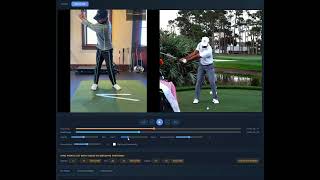
Using tools like Trackman or Swing Box, we can analyze the movements of elite golfers. These technologies track the center of the hips during the swing and provide valuable insights. For instance, when you set up for your shot, the center of your hips can be represented by a blue circle. As you begin your backswing, you will notice a slight lateral movement—this is essential for creating a more dynamic swing.
The Concept of Reentering
As you progress through your swing, particularly as your lead arm reaches parallel to the ground, you should observe a shift back toward the target. This movement is referred to as reentering. It’s a critical part of the swing that allows you to return to a position similar to your setup but with a slight downward angle. This transition is not only natural but necessary for generating optimal power.
The Importance of Lateral Movement
By the time you reach impact, your hips should have moved significantly from their original position. For example, you might find that your hips have shifted forward by six to eight inches or even more, as seen in players like Scotty Scheffler, who can achieve up to nine inches of lateral movement.
This lateral motion is crucial for several reasons:
- Power Generation: The hips act like a pendulum, creating a natural arc that contributes to the speed and power of your swing. A dynamic swing requires that your hips work in conjunction with your arms.
- Dynamic Movement: The hips should be thought of as swinging back and forth, similar to a bell. This movement not only adds fluidity to your swing but also helps in coordinating the arms and body.
- Enhanced Consistency: By embracing lateral movement, you can achieve more consistent results, as it allows for a better connection between your body and the club, resulting in more accurate shots.
Conclusion
In summary, understanding and incorporating lateral hip movement into your golf swing can have a transformative effect on your performance. By allowing your hips to move dynamically, you can generate more power and maintain better control over your swing. Embrace the concept of reentering and think of your hips as a swinging pendulum to maximize your potential on the course. As always, utilizing AI swing analysis tools can provide you with precise measurements and feedback, helping you refine these patterns for optimal results.
Key Takeaways
- Lateral hip movement is essential for a powerful golf swing.
- Modern technology can help visualize hip movement during the swing.
- The concept of reentering is crucial for maintaining a dynamic swing.
- Dynamic hip motion enhances consistency and accuracy in your shots.
- AI swing analysis can help measure and improve your hip movement patterns.
See What GOATY Finds in Your Swing
Upload a swing video and get your GOATScore, root cause diagnosis, and personalized drill prescription in 60 seconds.
Analyze My Swing Freeor
Try a Free Live LessonRelated Articles

How to Trim Your Golf Swing for GOATY Analysis
Learn the simple steps to trim your golf swing video for GOATY analysis and improve your game with AI insights.

Unlock Golf Power with the Sternum Graph Technique
Master your golf swing power by understanding the sternum graph. Learn how to utilize this technique for a more effectiv
Step-by-Step Guide to Building a GOAT Golf Swing
Learn how to build a GOAT golf swing step by step with insights from elite patterns and biomechanics.